
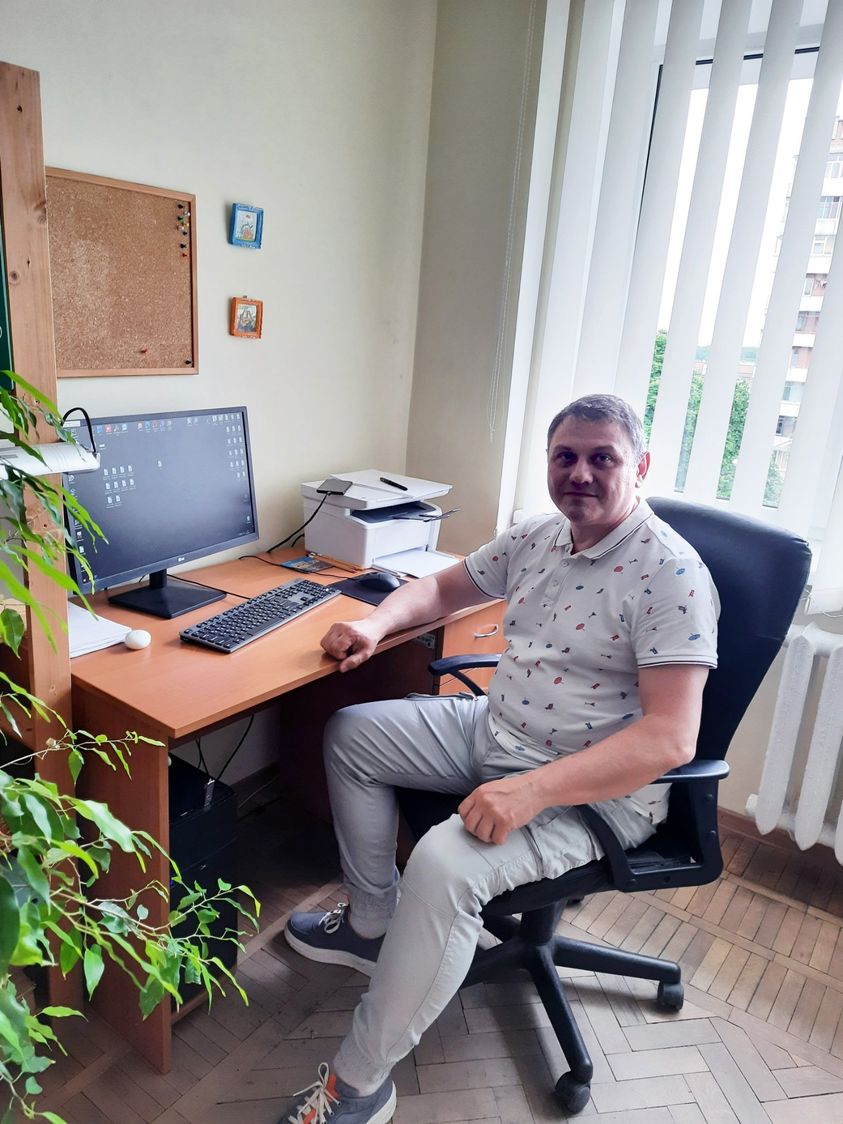
IT-CLUSTER FROM KRAMATORSK LOOKS FOR NEW CLIENTS IN LVIV

03 June 2022

In March 2022, the East Ukrainian Technocluster left Kramatorsk, Donetsk Oblast. Four of its member companies relocated their employees and computers to a safer place.

“I looked at the map of the war and decided that it was dangerous to stay at home any longer, so we had to go. It is impossible to work when the air raid alarm sounds constantly and the occupiers are firing rockets and heavy weapons. At such a time, you don’t think about work, but about saving your life,” says Pavlo Zaitsev, IT-cluster head and director of Areal Development.

New challenges for the cluster

In Lviv the cluster rented premises and set up a temporary office. Partners helped to find apartments for employees to live in. The first thing they did was to get acquainted with local IT business and potential clients from the municipal authorities and utility providers.

Each of the displaced companies – Areal Development, A-Soft Pro, K-X and VPS Service – has business projects and initiatives that promote the entire IT- cluster. One of the new proposals from Lviv colleagues is to take part in market research and compile an IT-map of Ukraine.

“Lviv colleagues got interested in the fact that now IT specialists from Donetsk region would work with them, so together we will be able to implement joint projects. For example, we have already agreed to take part in a study of Ukraine’s IT sector,” said Zaitsev. “How our cluster works: at a joint meeting we choose a project and start promotion by several companies, and find those who will help to implement ideas. Our Lviv colleagues have a different method. They come up with a more global initiative: to research the needs of Lviv’s IT companies, or to hold a Programmer’s Day. Then they invest money together in this idea. Despite these different approaches, businesses are uniting to achieve a greater goal. This is the essence of a cluster, in my opinion.”

Business interests are a separate story

In Kramatorsk, representatives of the cluster had regular customers such as city hospitals, small businesses and utility providers.

“Now the organizations that help locals survive during wartime – hospitals, emergency services, police and local authorities – have stayed in the city. They also need IT professionals to maintain their programs and configure software on their computers. Even now, we get requests from new customers. We can help only remotely,” says Zaitsev. “For example, we are now starting to work with doctors, our new clients from Kramatorsk who really need the help of IT specialists.”

Now in a new location, the firms have to look for clients again. Kramatorsk IT companies have begun to build new bridges.

“Now we have the idea of developing a replacement for C 1 accounting program,” says Zaitsev. “Surprisingly, Ukrainian businesses still use the Russian program. We have set ourselves the task of developing our own model, which will be an alternative.”

Another ambitious task of IT specialists from Donetsk Oblast is to create an ecosystem for accounting. This is a long process requiring thousands of hours of programming. Kramatorsk specialists are going to offer industry solutions – software for medicine, education and utilities – in which they already have experience.

There are other interesting ideas. When they were still in Donetsk region, Technocluster representatives began developing software for smart clothes. The first models of a jacket with heating were made at a local garment factory and series production was planned.

Now the cluster is reorienting the project to IT solutions in various fields: smart housing, smart farm and other areas. They are sure these are promising because people all over the world want comfort and convenience in their surroundings, and the task of IT is to help create this comfort by combining different sectors. Currently, Technocluster needs the help of international donors, and believes it will be able to implement its ideas.
ENTREPRENEUR FROM DONETSK OBLAST PROVIDES PIZZAS FREE OF CHARGE

31 May 2022

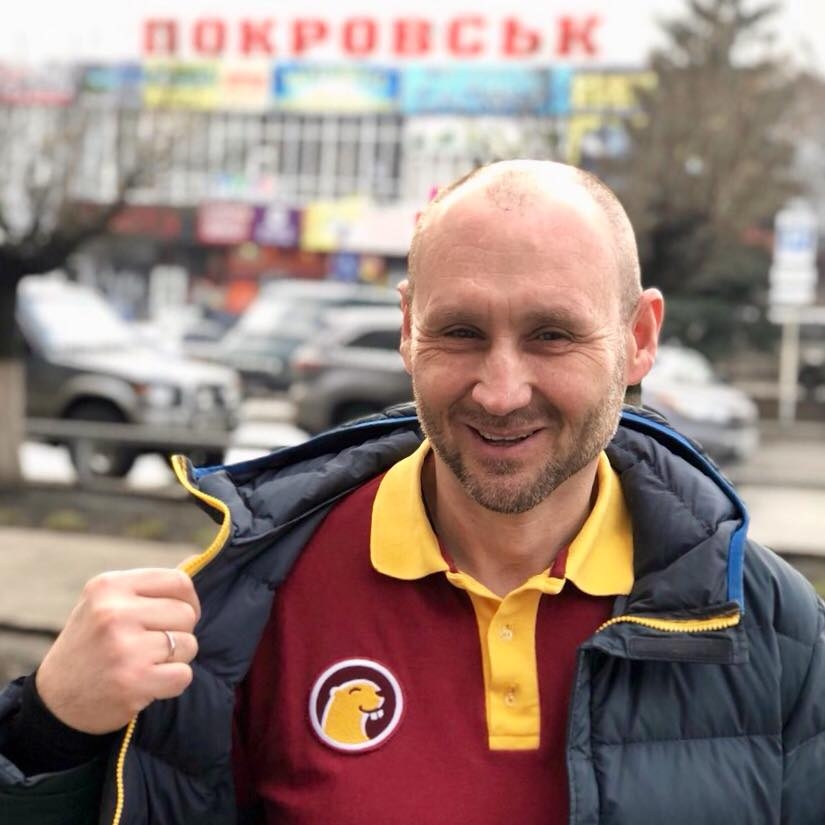
Ihor Vynohradov, an entrepreneur from Donetsk Oblast, moved equipment in April from his two pizzerias in Pokrovsk and Myrnohrad to the city of Dnipro. He now bakes up to 500 pizzas a day which he delivers to people in Donetsk Oblast who are hiding in shelters or basements due to shelling, or who are on medical treatment.

In Dnipro, Vynohradov rented production premises, including a well-equipped kitchen for cooking. The entrepreneur says that he was lucky because the space was already renovated, so he just had to install the equipment (a pizza oven and refrigerator) and start working.
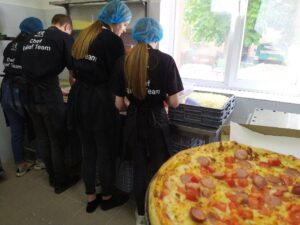
Friends suggested that he contact World Central Kitchen. This humanitarian aid organization helps catering establishments to cook food and distribute it to people who find themselves in difficult circumstances and cannot buy food. Within three weeks of signing an agreement with World Central Kitchen, Vynohradov’s team had baked more than 6,000 pizzas (more than 26,000 slices).

Before the war, Moko Pizza restaurant chain offered more than 30 varieties of pizza. Now Vynohradov’s team bakes up to 500 pizzas a day, and has developed a new recipe to fulfill this large daily order. Ingredients are purchased from supermarkets in Dnipro and local entrepreneurs.

“Because of the war, there are some problems with food supplies. We can’t make many different types of pizza on a large scale right now, as we need different cheeses, smoked meat and seafood. So our team has developed a new recipe. It’s simple enough, but it has all the ingredients: mozzarella, bacon, tomatoes,” says Vynohradov.

Before the war, Moko Pizza made dough that “ripened” in the refrigerator. This recipe is still used today to ensure a tasty product, despite the large volume and speed of cooking.

The customer, World Central Kitchen, decides where to deliver the pizzas. The businessman also cooperates with the city authorities of Pokrovsk and Myrnohrad, who are aware of the needs of residents remaining in Donetsk Oblast. Recently, his team delivered pizzas to children in foster families and visited frontline villages in Pokrovsk Raion.

“Twice a day we go to Donetsk Oblast to deliver orders. People are grateful when we bring them great pizzas. I am also glad that thanks to this project my team has work, the employees receive a salary and can feed their families,” Vynohradov says. “It’s not the format we are used to, but it’s the kind of work that is useful to people now, so we do it.”

Social responsibility in difficult times is not something new to the entrepreneur. When the coronavirus epidemic began in 2020, he delivered pizzas free of charge to accident and emergency doctors in Mariupol and Pokrovsk. In this way, he thanked the doctors who worked without days off, saving patients.

“A lot of people now are unemployed and homeless because of the war. Every day we see long queues of people who come to different centers for humanitarian aid. We can’t feed everyone, but we try to be useful. Only with World Central Kitchen can we continue to work and feed people in need now, and I am extremely grateful for that opportunity,” says Vynohradov.

The entrepreneur is still looking for locations in central Ukrainian cities to restart Moko Pizza as a business, where customers come to the pizzeria, choose a pizza of their choice and receive their orders in minutes.

Before the war, Vynohradov had four pizzerias in Pokrovsk, Myrnohrad and Mariupol. He lost his two branches in Mariupol when missiles hit the premises, destroying all the equipment. Despite these losses, he has not given up and continues to work every day, supporting other Ukrainians in difficult times.

ENTREPRENEUR FROM LUHANSK OBLAST HELPS INTERNALLY DISPLACED PEOPLE FROM KREMINNA

26 May 2022

Oleksandra (Olesia) Izuita, an entrepreneur from Luhansk Oblast, is helping organize provision of humanitarian aid in Vinnytsia for displaced people from the city of Kreminna (Luhansk Oblast). At the same time, Izuita herself is an internally displaced person (IDP) twice over.

Izuita had to leave her hometown of Luhansk in 2014, when war broke out. An actress by education, she worked as art director of an entertainment center and ran a group of party entertainers. Together with her family, she moved to the town of Kreminna, and started thinking about how to earn a living there. As there was no children’s entertainment center in the small town, Izuita decided this might be a promising project.

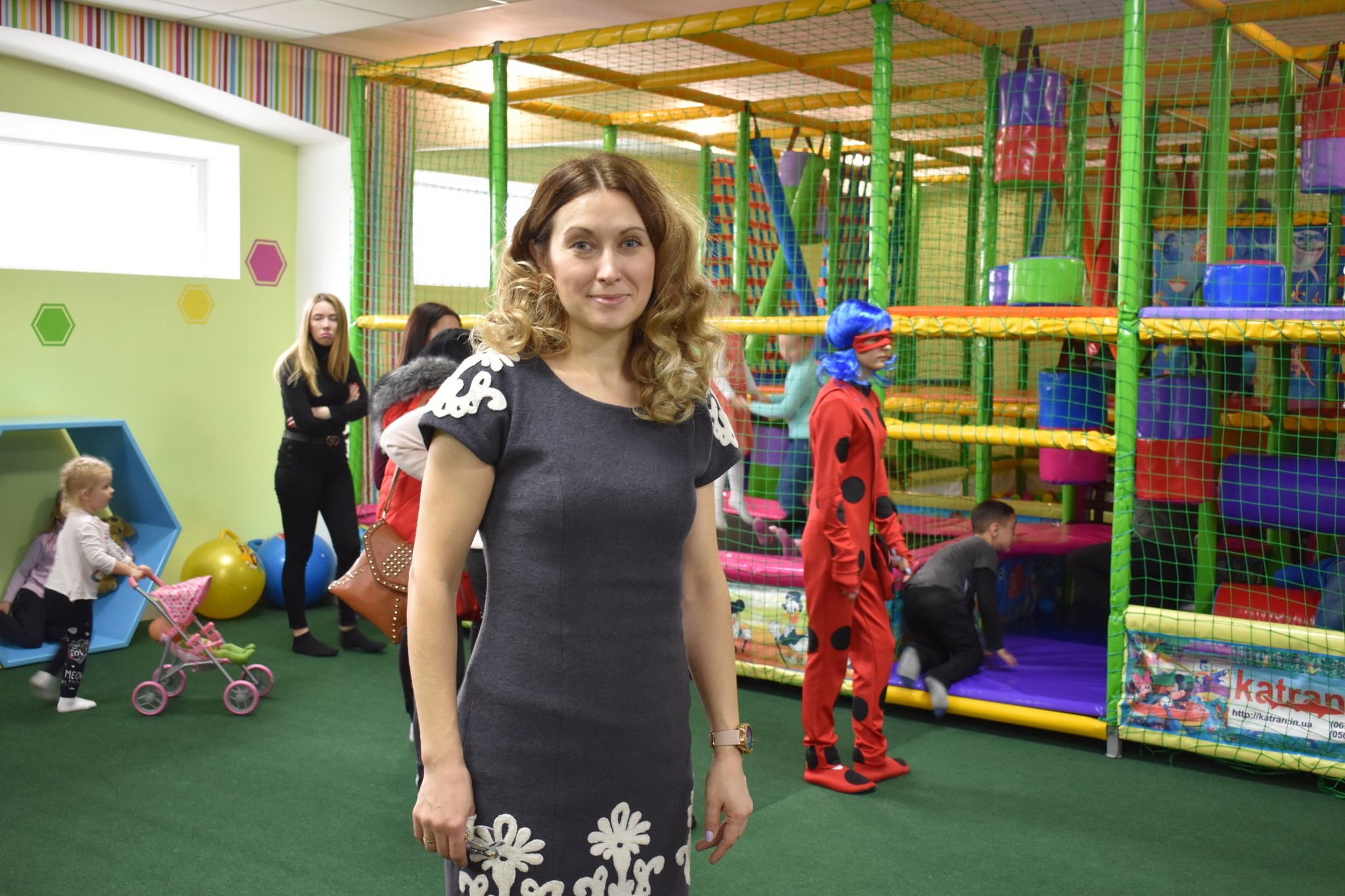
In 2019, with grant support from international donors, Izuita created Mosaic children’s entertainment center, where children could come to play air hockey and on trampolines, and celebrate birthdays among bright balloons.

A team of entertainers worked with Izuita. Gradually, teenagers who had no place to go in the town began to gather near the center, which was bustling with younger children having fun. Izuita decided to organize the teenagers into a youth organization called Charivnyi Pendel. The teenagers began to get involved in volunteering, eco-camps, trainings and trips. Together they were preparing to open the first hub in the city when on February 24, Russia attacked Ukraine, halting all these plans and projects.

In March, Izuita and her family left Kreminna. All the equipment they had bought remained in her center, as she became an internally displaced person for the second time.

“I regret that I didn’t take the equipment out of the center when I had the opportunity to do so,” she says. “Back then I thought, who needs children’s entertainment if there is war in Ukraine? Now it’s too risky to go to Luhansk Oblast. Kreminna is occupied, and I don’t know what happened to my center.”

The family moved to Vinnytsia, where Izuita became a volunteer.

“In the early days of the war, I applied for a small grant from the Danish Refugee Council. I knew how to submit such applications because I already had experience in communicating with donors. My application for assistance to residents of Donetsk and Luhansk Oblasts was approved,” says Izuita.

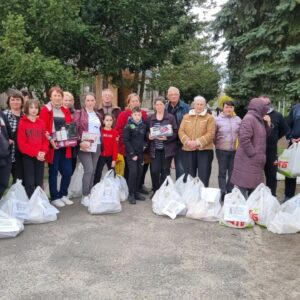
By the time the money for the grant was allocated, Kreminna was already under occupation. So Izuita started buying food and delivering it to places where residents of Kreminna were concentrated.

“I realized that many people who had fled from shelling did not have basic necessities,” she says. “They needed pillows, kettles and hygiene products. I saw one situation where people were living in a dormitory. There was one electric kettle for the whole floor, which everyone was using to heat water for tea and for washing themselves. At the same time, people were given pasta and cereal every day, but in fact they often did not need it at all.”

A team of teenagers who had attended Izuita’s center created a Telegram channel for residents of Kreminna who had been forced to leave their homes. Mykyta Horbatenko, 17, set up the channel, which helped unite Kreminna residents now scattered to Vinnytsia, Volyn, Dnipro, Rivne, Cherkasy and other regions.

The channel was useful to identify coordinators and needs in each city. Retired people need food and medicine, while middle-aged people need information and know-how. “This is what migrants are saying. It inspires me that people are ready to work, study, and adapt to life in a new place,” says Izuita.

You can join the channel at the link

Izuita says that in a few months she had to get used to traveling in new forms of transport, like trucks. She learned the locations of wholesale warehouses, and the tricks of negotiating a discount in supermarkets when buying products for humanitarian aid. She worked out how to support IDPs from the east who sew bed linen.

“It’s not something I’m used to doing at home, but if it can be useful now, I’ll do it,” she says.

She is also looking for an opportunity to open an early childhood development center in Vinnytsia for pre-schoolers.

Izuita believes that cozy green Kreminna will be under the Ukrainian flag again soon, and she will return to her center to develop her small town in Luhansk Oblast together with her children.